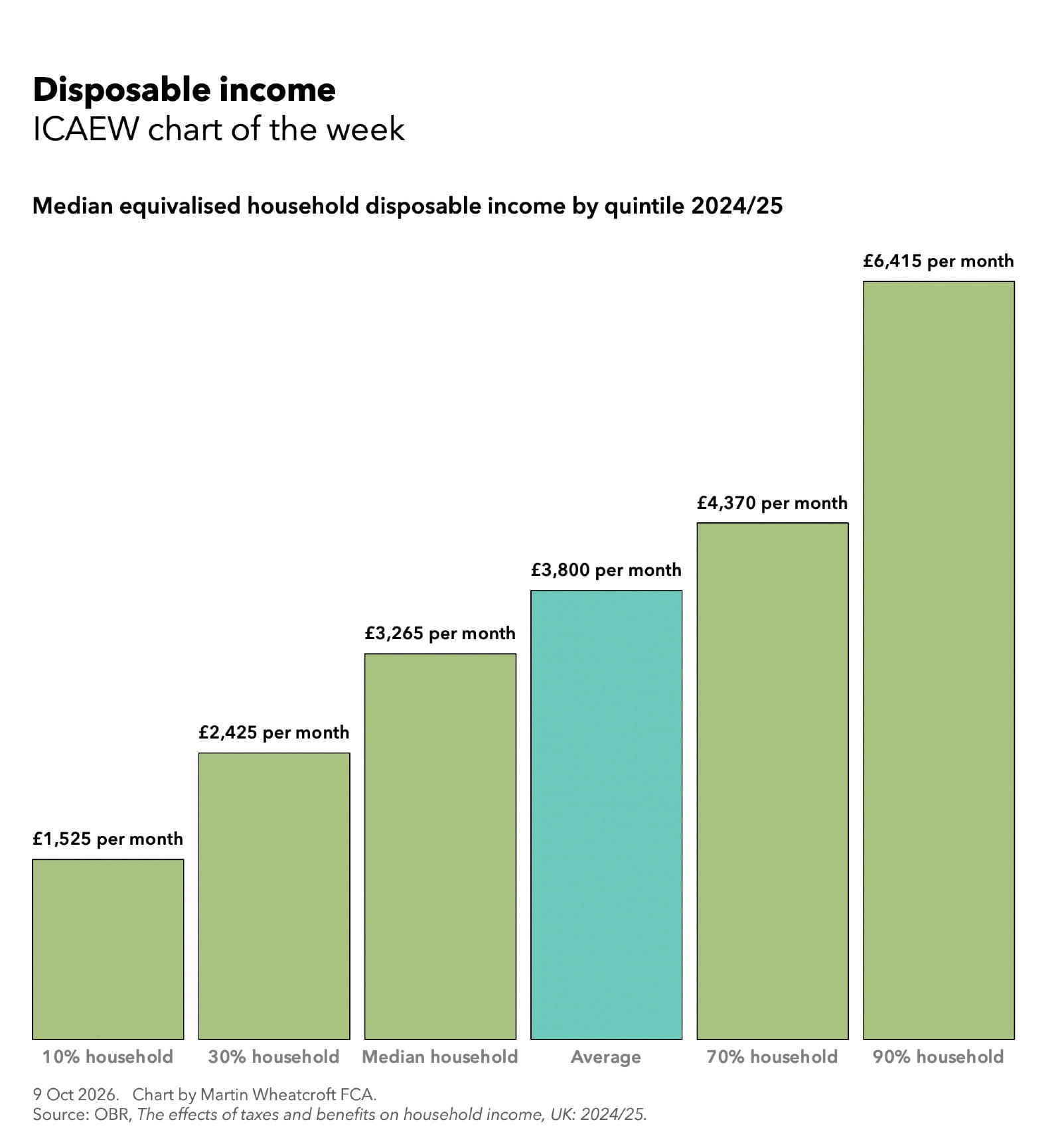
The ONS released its latest statistics on average household income (after adjustment for the effects of taxes and benefits) on 2 October 2026, covering financial years up until 2024/25 (the financial year ended 31 March 2025). Household disposable income is calculated as household gross income including salary, private pensions, investment income and welfare benefits (including the state pension) minus income tax and employee or self-employed national insurance.
The ONS reported that the median household disposable income on an equivalised basis was £39,200 in 2024/25 or £3,265 per month, while the equivalised average was £45,600 or £3,800 per month. The average is higher than the median (the household at the mid-point of the distribution) because of higher earnings at the top end.
Our chart this week shows these data points together with median household disposable income for the bottom fifth of the population – the household 10% of the way along the distribution – of £18,300 or £1,525 per month, the 30% household of £29,100 or £2,425 per month, the 70% household of £42,450 or £4,370 per month, and the household at the 90% point (the median of the top quintile) of £77,000 or £6,415 per month.
Median and average household equivalised disposable incomes in 2024/25 for retired households were £2,775 and £3,150 per month respectively, around four-fifths of the median and average of non-retired households of £3,400 and £3,935 per month.
Equivalisation to a ‘standard’ household
These amounts are calculated on an equivalised basis, which adjusts different household sizes to a standard size to provide comparability between different living arrangements. This has the effect of shifting larger families with children down the distribution to reflect their higher cost of living, while single person households with no children are shifted upwards.
The ONS calculates the equivalised amount by dividing household disposable income over an amount equal to 0.67 for the first adult plus 0.33 for each other adult in the household plus 0.2 for each child. This standardises the numbers to a household of two adults with no children.
On a non-equivalised basis, average household disposable income in 2024/25 was £56,300 or £4,690 per month, reflecting an average household size of two adults and 1.15 children or other ‘equivalent’ combinations.
ICAEW on the budget

Latest charts
Stay up to date
You can receive regular email updates from ICAEW insights, including weekly or monthly enewsletters. Subscribe to whichever works for you.
Sign upFurther resources
ICAEW Community

Public Sector Community
The go-to place for guidance on issues affecting finance professionals working in and with the public sector. With a range of dynamic services, ICAEW provides valuable tools, resources and support tailored to the public sector.
Resources

Economy explainers
ICAEW experts offer simple guides to help understand the technical, economic jargon that is discussed when talking about public finances and the economy.
Find out moreICAEW support

Training and events
Browse upcoming and on-demand ICAEW events and webinars offering support on technical areas, such as assurance, reporting and tax, as well as personal development.
Events and webinars A-Z of courses