Our weekly chart returns after the summer into a turbulent time for investors in sovereign debt. Yields have risen significantly, especially in the past six months since the start of the war with Iran.
This is important to all of us because government bond yields not only represent the effective interest rates that countries (and their taxpayers) will incur when they borrow, but they also feed through into the cost of borrowing for individuals and business. The interest rates payable on mortgages, corporate bonds and long-term business loans are usually affected much more by long-dated government bond yields than they are by short-term central bank base rates.
30-year government bond yields
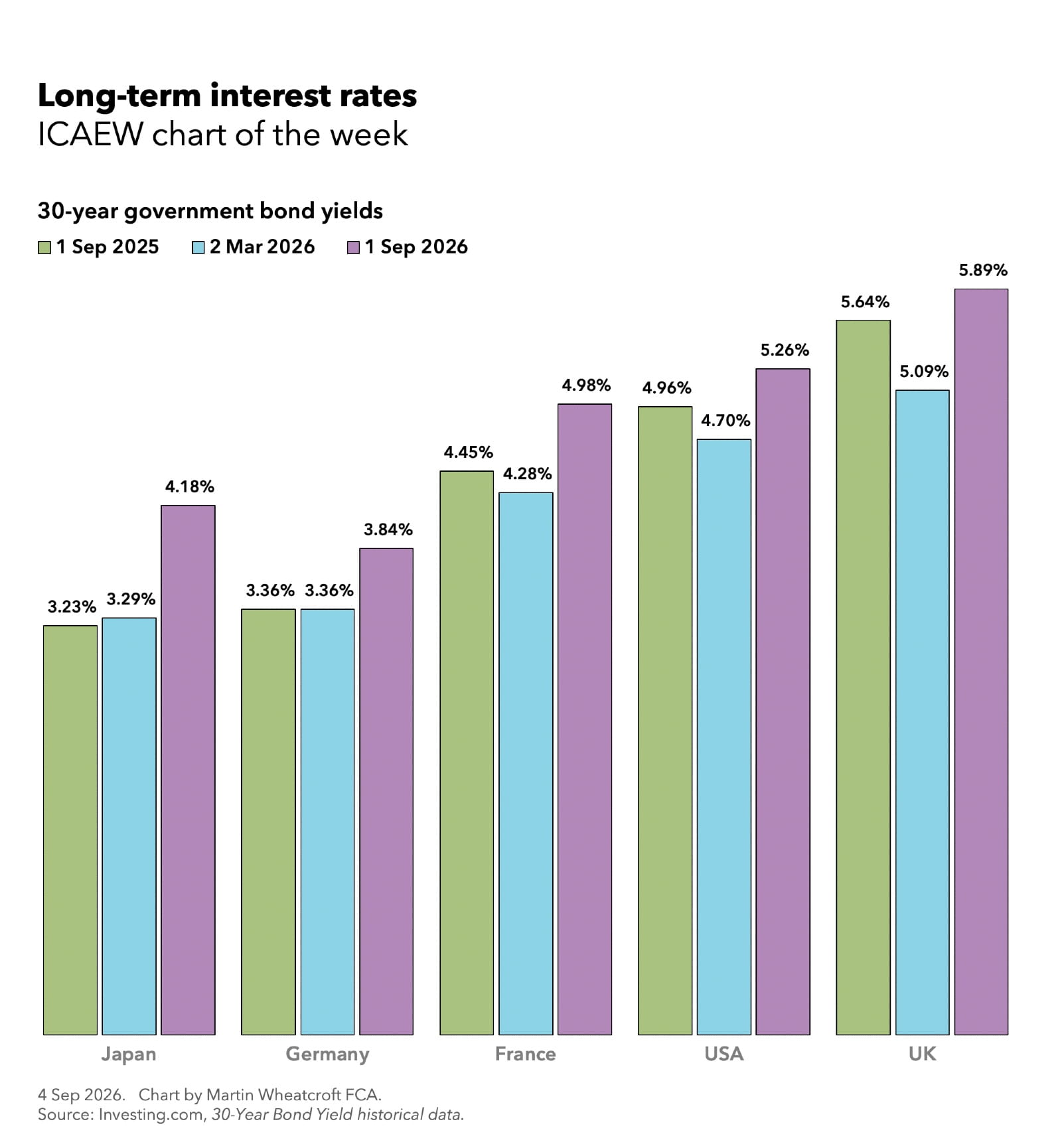
Our chart illustrates how 30-year government bond yields have risen compared with six months and a year ago in Japan, Germany, France, the US and the UK.
- Japan has seen the most dramatic rise, with its 30-year yield going from 3.23% on 1 September 2025 and 3.29% on 2 March 2026 to 4.18% on 1 September 2026 – an increase of 0.95 percentage points or 95 basis points over the year, almost all of it since the spring.
- Germany continues to be the cheapest borrower of the five countries, but its yield has still risen from 3.36% a year ago and in March to 3.84% today, up 48 basis points.
- France has gone from 4.45% to 4.28% to 4.98%, a rise of 53 basis points over the year but 70 basis points over six months.
- The US has moved from 4.96% to 4.70% to 5.26%, up 30 basis points over the year and 56 basis points over six months.
- The UK remains the most expensive long-term borrower of the five at 5.89% on 1 September 2026, its highest 30-year yield since 1998. This is up 25 basis points from 5.64% a year ago and 80 basis points higher than the 5.09% recorded in March – the smallest rise of the five over the year, but the second largest over six months.
For context, the IMF estimates that general government net debt/GDP in 2026 will be 134% in Japan, 49% in Germany, 110% in France, 99% in the US and 96% in the UK.
Factors behind the rise in long-term interest rates
Probably the most significant reason for the fall in government bond prices and the consequential rise in yields over the last six months has been the war with Iran and the disruption it has caused to energy and other critical supplies.
Yields have also been exacerbated by a larger supply of debt, with government bond issues competing with central banks selling down their quantitative easing holdings and private sector borrowers raising large sums to finance the AI boom.
While long-term interest rates have generally risen across the world, there are country-specific factors at play.
- Japan has seen the biggest rise in 30-year yields reflecting a shift from three decades of zero or negative short-term interest rates and low inflation to higher rates of both, combined with a weaker yen and larger fiscal deficits.
- The US matters most to the global economy given the scale of its borrowing, with a deficit heading towards $2tn a year and with the Federal Reserve now expected to raise the federal funds rate rather than cut it.
- The UK is more exposed to inflation than many other countries through its index-linked gilts, with higher rates of inflation increasing both the coupons that are payable as well as the amount of principal to be repaid.
Fiscal credibility
Another key factor influencing bond yields is fiscal credibility, or rather concerns about it, which matters a lot to investors lending for as long as 30 years.
This is perhaps best illustrated by the 114 basis points spread in the cost of borrowing for a 30-year period between Germany’s 3.84% and France’s 4.98% on 1 September 2026, despite them being in a common market together and sharing the same currency.
Fiscal credibility is a particular concern for debt investors in the UK in the run up to the Budget on 28 October, especially as higher debt servicing costs and other cost pressures are expected to reduce the government’s headroom against its fiscal rules. This will make it that much more difficult for a Chancellor who would dearly like to invest more in economic growth but lacks the fiscal firepower with which to do so.
Latest charts
Stay up to date
You can receive regular email updates from ICAEW insights, including weekly or monthly enewsletters. Subscribe to whichever works for you.
Sign upFurther resources
ICAEW Community

Public Sector Community
The go-to place for guidance on issues affecting finance professionals working in and with the public sector. With a range of dynamic services, ICAEW provides valuable tools, resources and support tailored to the public sector.
Resources

Economy explainers
ICAEW experts offer simple guides to help understand the technical, economic jargon that is discussed when talking about public finances and the economy.
Find out moreICAEW support

Training and events
Browse upcoming and on-demand ICAEW events and webinars offering support on technical areas, such as assurance, reporting and tax, as well as personal development.
Events and webinars A-Z of courses