The Office for Budget Responsibility (OBR) updated its long-term fiscal projections over the summer, and the results were not good.
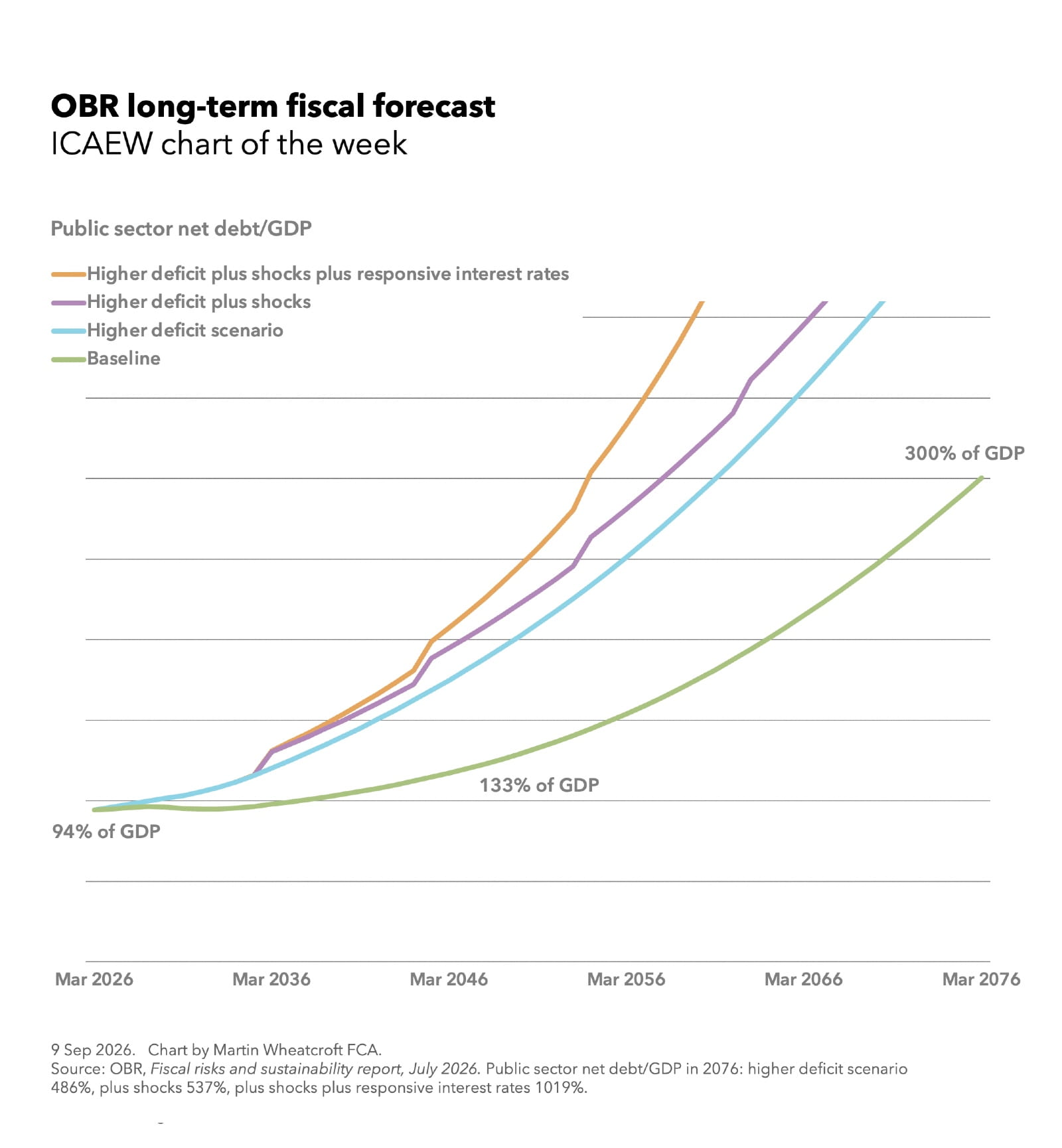
The OBR’s baseline projection sees the ratio of public sector net debt to GDP rising from 94% in March 2026 to reach 300% of GDP in 50 years’ time. This is up from a projected 274% of GDP in the last full update in 2024.
Worryingly, the alternate scenarios presented by the OBR – what happens if things don’t proceed as expected – are literally off our chart.
The OBR’s higher deficit scenario, in which the government fails to bring the deficit down over the next five years as intended, sees debt move onto an unsustainable path much sooner to reach 486% of GDP in March 2076, while if likely economic shocks are included net debt could reach 537% of GDP. The OBR’s most extreme scenario, reflecting the likely response of interest rates to increasing levels of indebtedness, sees net debt spiralling out of control to reach 1019% of GDP in 2076.
Good and bad news
The good news about these projections is that they will not come to pass.
The bad news is that governments over the next 50 years will need to do something to ensure they don’t.
This is because a fundamental assumption underpinning the projections – that the economy and public finances continue their current path – is not what will happen. Even if governments wanted to increase debt to such levels (which they don’t), markets would not allow them to. The OBR’s projections are not a prediction but a warning.
The Chancellor’s choices are constrained in the amount that he can borrow because of the need to retain the confidence of debt markets. He has inherited a medium-term plan that sees the government borrowing more in the next two to three years to fund investment but then constraining both current public spending and investment with the aim of bringing down debt as a share of the economy.
Start turning around the public finances
ICAEW’s submission to Budget 2026 calls for action to start turning around the public finances and to give businesses breathing space to deliver growth. This includes near-term measures to stabilise the current fiscal situation, a credible medium-term fiscal forecast to improve market and business confidence, and the need to develop a long-term fiscal strategy.
ICAEW on the budget

Latest charts
Stay up to date
You can receive regular email updates from ICAEW insights, including weekly or monthly enewsletters. Subscribe to whichever works for you.
Sign upFurther resources
ICAEW Community

Public Sector Community
The go-to place for guidance on issues affecting finance professionals working in and with the public sector. With a range of dynamic services, ICAEW provides valuable tools, resources and support tailored to the public sector.
Resources

Economy explainers
ICAEW experts offer simple guides to help understand the technical, economic jargon that is discussed when talking about public finances and the economy.
Find out moreICAEW support

Training and events
Browse upcoming and on-demand ICAEW events and webinars offering support on technical areas, such as assurance, reporting and tax, as well as personal development.
Events and webinars A-Z of courses