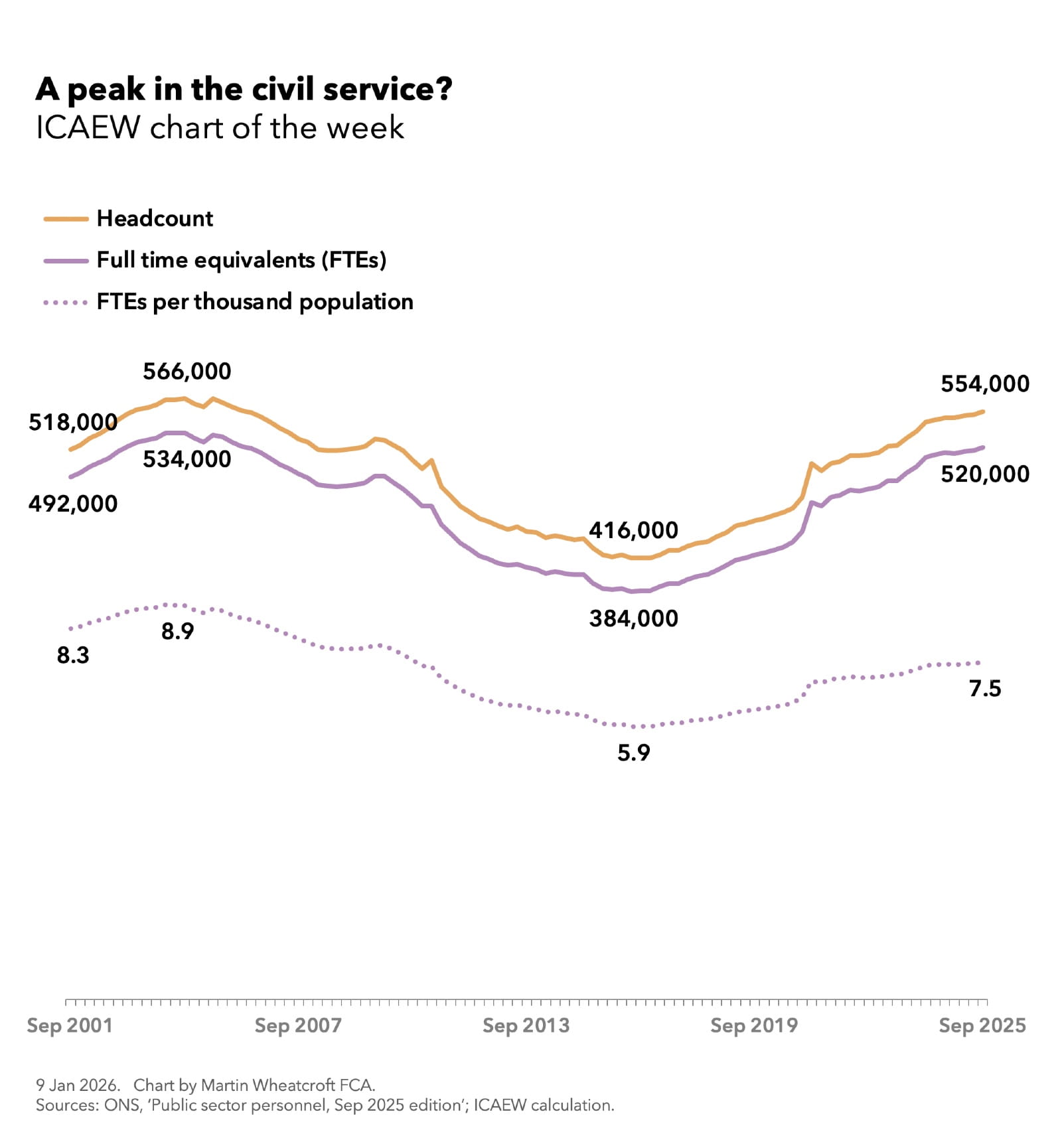
Our chart this week takes a look at how the size of the civil service has risen, fallen, and risen again over the last 24 years.
According to the Office for National Statistics (ONS), there were 518,000 civil servants or 492,000 full time equivalents (FTEs) in September 2001. This rose to 566,000 or 534,000 FTEs in September 2004, before gradually falling over the following decade or so to 416,000 or 384,000 FTEs in June 2016. Numbers started to increase from that point, rising to 554,000 or 520,000 FTEs in September 2025.
The decline in the number of civil servants during the Cameron-led coalition government between 2010 and 2015 reflected a concerted attempt to reduce costs, but the cuts were brought to a shuddering halt following the UK’s decision to leave the European Union.
This saw civil numbers grow firstly to prepare for Brexit from the summer of 2016 onwards and then following the reverse economies of scale from the UK’s departure from the EU in January 2020 and from the EU single market and customs union in December 2020. Functions including trade relationships, customs, farm subsidies, regional economic development and multiple strands of regulation (economic, financial, food, medical, chemical etc) have all returned from Brussels, requiring more civil servants to deal with each. Although Covid boosted numbers further in 2020 and 2021, the rise has continued steadily since then as government departments have become even busier due to a range of factors, including rising numbers of immigrants and asylum seekers.
Our chart also shows how the ratio of civil servant FTEs to the population increased from 8.3 per thousand people in September 2001 to 8.9 in September 2004 and then fell to 5.9 in June 2016 before rising back to 7.5 per thousand in September 2025. This makes the increase since 2016 look a little less dramatic, as high levels of net inward migration has driven up the size of the population in recent years.
The civil service is the core policy and administrative staff working for central government departments and agencies (including those of the Scottish and Welsh governments) and is a subset of the 6.2m people (5.2m FTEs) who worked in the public sector in September 2025. This excludes the 2.3m employees (2.0m FTEs) of the NHS and other public health and social work services, the 1.7m people (1.2m FTEs) working in education, the 0.4m (0.4m FTEs) in the armed forces and police, and 1.3m (1.0m FTEs) total for council workers, employees of public corporations (such as the Post Office), and other public or crown servants.
The UK government set out a plan in the Spending Review 2025 covering the three financial years from 1 April 2026 to 31 March 2029 to cut administration budgets by 16% in real terms, with cuts in the numbers of civil servants expected to contribute a significant proportion of these savings.
The National Audit Office estimates that around 8,500 civil servants are expected to leave the civil service by March 2027 under existing exit schemes, but this is likely to be only a small proportion of the total that will need to leave if the government is to be successful in its objective.
The peak in the size of the civil service has been called many times before, but this analysis (cautiously) suggests that the most likely peak will fall in either September 2025, December 2025 or March 2026, after which the civil service is expected to begin shrinking.
Latest charts
Further resources
ICAEW Community

Public Sector Community
The go-to place for guidance on issues affecting finance professionals working in and with the public sector. With a range of dynamic services, ICAEW provides valuable tools, resources and support tailored to the public sector.
Resources

Economy explainers
ICAEW experts offer simple guides to help understand the technical, economic jargon that is discussed when talking about public finances and the economy.
Find out moreICAEW support

Training and events
Browse upcoming and on-demand ICAEW events and webinars offering support on technical areas, such as assurance, reporting and tax, as well as personal development.
Events and webinars A-Z of courses