
Edinburgh Fringe
Every August, Edinburgh transforms into the absolute epicentre of the arts world as it hosts Edinburgh Fringe, with thousands of performers trying to persuade visitors that their show is the one worth your time and money.
The city becomes a maze of comedians, musicians, actors, writers and street performers, and practically every available wall, railing and lamppost is covered with posters fighting for your attention. Some productions have been at Fringe for decades, others are putting themselves out there for the very first time. That variety is a huge part of the appeal of Edinburgh Fringe: you can move from a polished show in a theatre to a first-time comedian in the basement of a pub, and it all feels very normal.
We were at Fringe for two reasons. The first was to watch my (Giles) brother-in-law’s musical, The Shocking Truth About Flat Earth, which he wrote and produced with his friend. If you have ever seen one of my Humble MVP music videos, you have already encountered his work because he is the musical genius behind them.
The second reason was to see David Benaim perform his Excel comedy show. Only at the Edinburgh Fringe could a musical about Flat Earth and a stand-up show about spreadsheets sit comfortably within the same weekend’s entertainment!
The Excel comedian
Many ICAEW readers will already know of David. He is one of the best Microsoft MVPs in the world, a brilliant trainer and a regular voice within the ICAEW community. Some of you may have attended one of his courses or webinars, or read one of his articles, without ever realising that he has also been passionate about stand-up comedy for as long as we have known him.
David is unusual in another respect too, because alongside Microsoft products he also teaches Google Sheets. Spreadsheet communities can be surprisingly tribal, so anyone able to move fluently between Excel and Google Sheets, while remaining popular with users of both, deserves recognition. More importantly, he has the ability to take technical material and make it feel approachable, which is central to both his training and his comedy.
Excel is not the most obvious source of stand-up material. Most of us struggle to convince friends and family that a new formula is exciting, never mind funny, but David has managed to build a routine that mixes genuine Excel tips with spreadsheet puns, graph-based humour and a little bit of naughtiness (it was the Fringe, after all).

When an audience gasps at Excel
The show was brilliant, but what surprised us most was not simply that the jokes landed. It was the audience’s reaction to the Excel content itself. David would move from a punchline into a genuine demonstration of an Excel feature, and on several occasions people in the room audibly gasped at a shortcut or technique they had not seen before. There is something wonderfully strange about hearing an audience react to an Excel tip as though they have just witnessed a major plot twist.
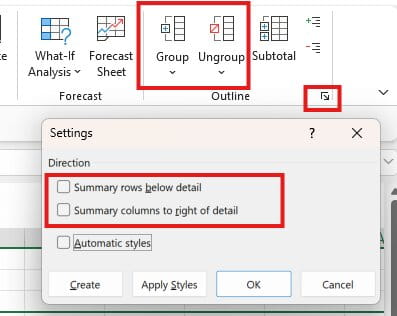
For example, many people in the audience proudly admitted to using the hide/unhide feature for rows or columns before David showed why using Grouping is far superior. Have you ever wondered why the + icon appears below or to the right of the section you’ve grouped, rather than just above, or to the left of it (which feels much more natural!) Try unticking the two boxes under the “Direction” section within the Settings and see what happens!
The audience gasps we heard throughout David’s performance told us a lot about his preparation for his set. The tips were not bolted onto the comedy for the sake of it; they were part of the rhythm of the show, so people remained attentive and curious. One minute they were laughing at a terrible spreadsheet pun, the next they were learning something that could save them time when they returned to work.
Those moments also made us think about how often useful knowledge is lost through the way it is communicated.
In finance, accounting and technology, we deal with subjects that can be complicated, technical and occasionally dry. We sometimes assume that the importance of the material should be enough to command attention, but audiences rarely work that way. If we want people to understand an idea, adopt a new process or remember a technique, we have to earn their interest and ongoing attention.
Making complex ideas engaging
The best trainers and presenters do more than simply understand their subject. They know how to structure an explanation, where an audience is likely to become lost, and when a story, example or joke will make a concept easier to absorb. That does not mean every finance presentation needs to become a comedy routine, but it does mean that clarity and engagement deserve as much thought as technical accuracy.
Whether we are explaining a model to a colleague, presenting analysis to a leadership team or encouraging people to change an established process, the information only creates value if the other party understands what it means and why it matters.
Humour is particularly effective because it lowers the barrier to subjects that people may find intimidating. Excel is a familiar tool, but many users still worry that everyone else knows more than they do. A relaxed, entertaining environment makes it easier to admit that you have never used or seen a feature before. David’s show was, in part, a genuinely effective Excel training session because the comedy did not distract from the learning; it created unique conditions for the learning to happen.

You cannot prepare for every outcome
David had come prepared. This was not an experimental first attempt at combining spreadsheets and stand-up; he has performed the routine many times, and the material was polished. The audience was happy, the jokes were working and the Excel demonstrations were producing exactly the response he had hoped for. He had done everything within his control to make the show a success.
Then the rain arrived.
Scotland is not exactly famous for predictable or sun-blessed weather, but this was something else. Torrential rain led to the venue flooding halfway through the performance, and the show had to be cut short. No amount of rehearsal, technical knowledge or carefully timed comedy can fully prepare you for water entering the room while you are trying to explain Excel. Copilot, as it turned out, was also no help when it came to turning off the weather.
It was frustrating, of course, but it also felt like a fitting ending to our story. In business we spend a great deal of time trying to anticipate what might happen next. We build forecasts, assess risks, model scenarios and prepare contingency plans, all of which are sensible and necessary. Yet there will always be outcomes that sit beyond our reasonable control.
Such is life
A few weeks before the Fringe, we had been with David at Bletchley Park, surrounded by the history of codebreaking and early computing. This time we were in Edinburgh, watching him turn Excel into live comedy before the venue began to flood. Neither experience is quite what most people imagine when they think about a career involving spreadsheets, which is probably why we enjoyed both so much.
The show left us with two thoughts. The first is that complex ideas become far more accessible when they are presented with personality, enthusiasm and a genuine understanding of the audience. Technical expertise matters enormously, but the ability to communicate that expertise is what allows it to travel beyond the person who holds it.
The second is that preparation matters, but it does not create certainty. We should plan carefully, rehearse properly and think about the risks we can reasonably foresee, while accepting that we will never account for every outcome. Sometimes the formula works, the audience is happy and the rain still comes through the ceiling.
Such is life.

Archive and Knowledge Base
This archive of Excel Community content from the ION platform will allow you to read the content of the articles but the functionality on the pages is limited. The ION search box, tags and navigation buttons on the archived pages will not work. Pages will load more slowly than a live website. You may be able to follow links to other articles but if this does not work, please return to the archive search. You can also search our Knowledge Base for access to all articles, new and archived, organised by topic.
- Cells, Chaos, and Collaboration: Excel on The Road in Amsterdam
- Global Excel Summit 2026: The sum of what you missed, sorted by where to begin
- Excel on the Road is… back on the road!
- From codebreaking to spreadsheets: what Bletchley Park can teach today’s Excel users
- Edinburgh Fringe: Excel comedy laced with tips, and flat earth believers
