Chartered Accountants' Hall, headquarters of ICAEW in the City of London, was built between 1890 and 1893. The original Hall, fronting on Moorgate Place, was designed by the architect John Belcher RA, whose plans had been successful in open competition. It was opened in 1893 by the President of the day, Edwin Waterhouse.
Overview

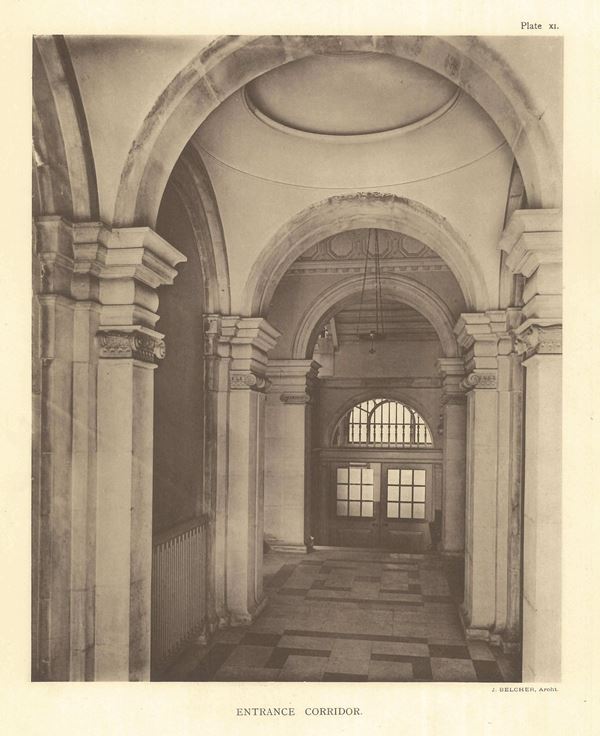
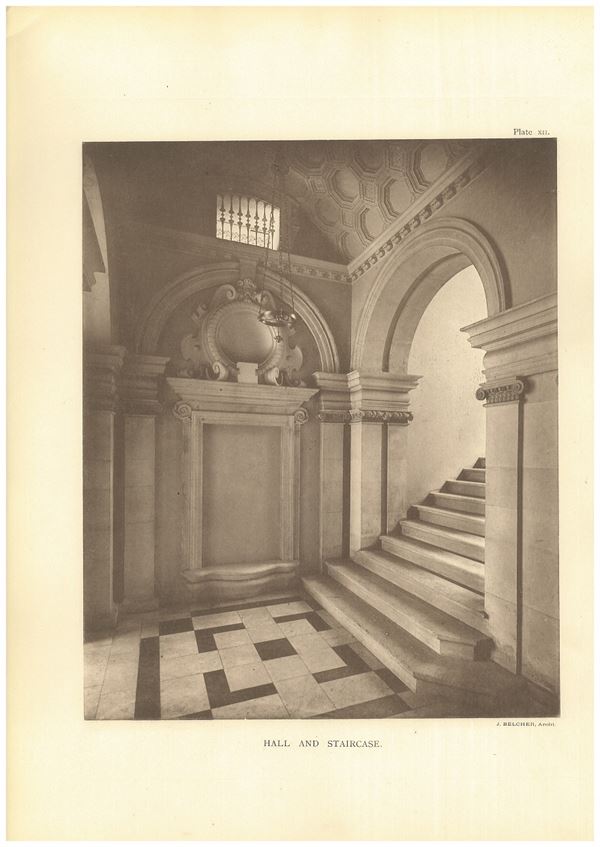
Described by architectural historian Sir Nikolaus Pevsner as ‘eminently original and delightfully picturesque’, Chartered Accountant's Hall is a fine example of Victorian neo-Baroque. At the time the design was somewhat controversial, as it was a considerable move away from traditional Victorian style. Its architect John Belcher drew inspiration from the work of the Italian Renaissance, which he had seen while travelling in Europe. Some sources attribute the building as a joint design by Belcher along with Arthur Beresford Pite, a friend and partner in his practice.
Eminently original and delightfully picturesque"


The foundation stone for the original building was laid on 8 July 1890 by ICAEW President Joseph John Saffery and the silver trowel used in the ceremony can be seen on display in the Business Centre. Enough progress had been made with the building that ICAEW staff were able to take up residence from 10 December 1892 and examinations were held on site from this date. The builders were Colls & Sons of Coleman Street E.C., with Mr G. Smith acting as clerk of works.
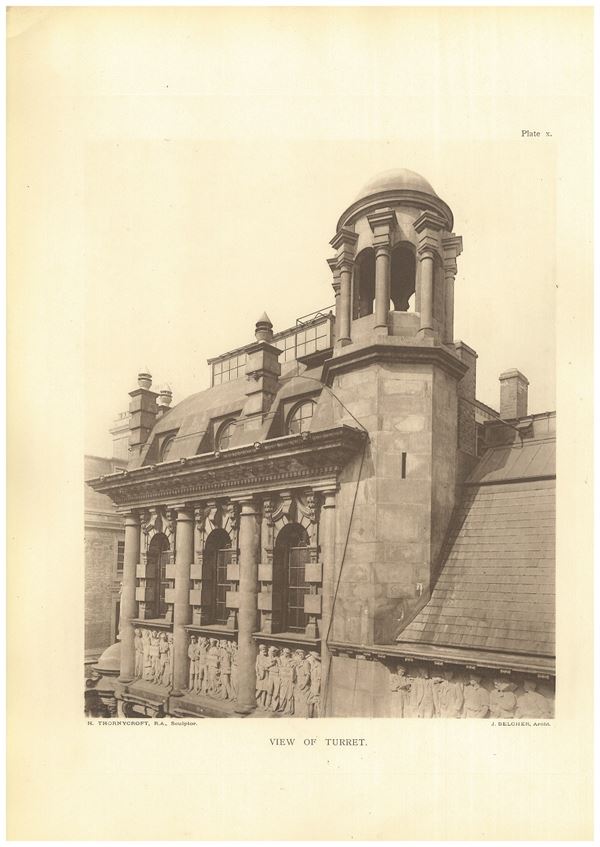
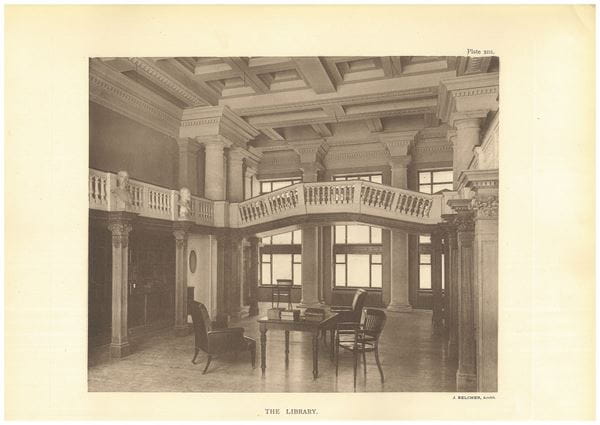
The original design featured opulent interiors, including an arched indoor bridge inspired by the Rialto Bridge in Venice and stained-glass windows by renowned Victorian artist Henry Holiday. The exterior was equally finely decorated with stone friezes and sculpture by renowned sculptors Hamo Thornycroft RA and Harry Bates ARA, with subsidiary carving from Messrs. Farmer and Brindley. The friezes show figures from a wide range of industries which have benefited from the services of accountants, including the arts, sciences, education, manufacturing, architecture, railways and mining.
When the building was officially opened in 1893, ICAEW had just 1,700 members.
In 1913 the RIBA journal described Chartered Accountants' Hall as ‘a standing monument to the happy results that can be attained by the sympathetic collaboration of the architect, the sculptor and the painter’.


1893 Floor plans

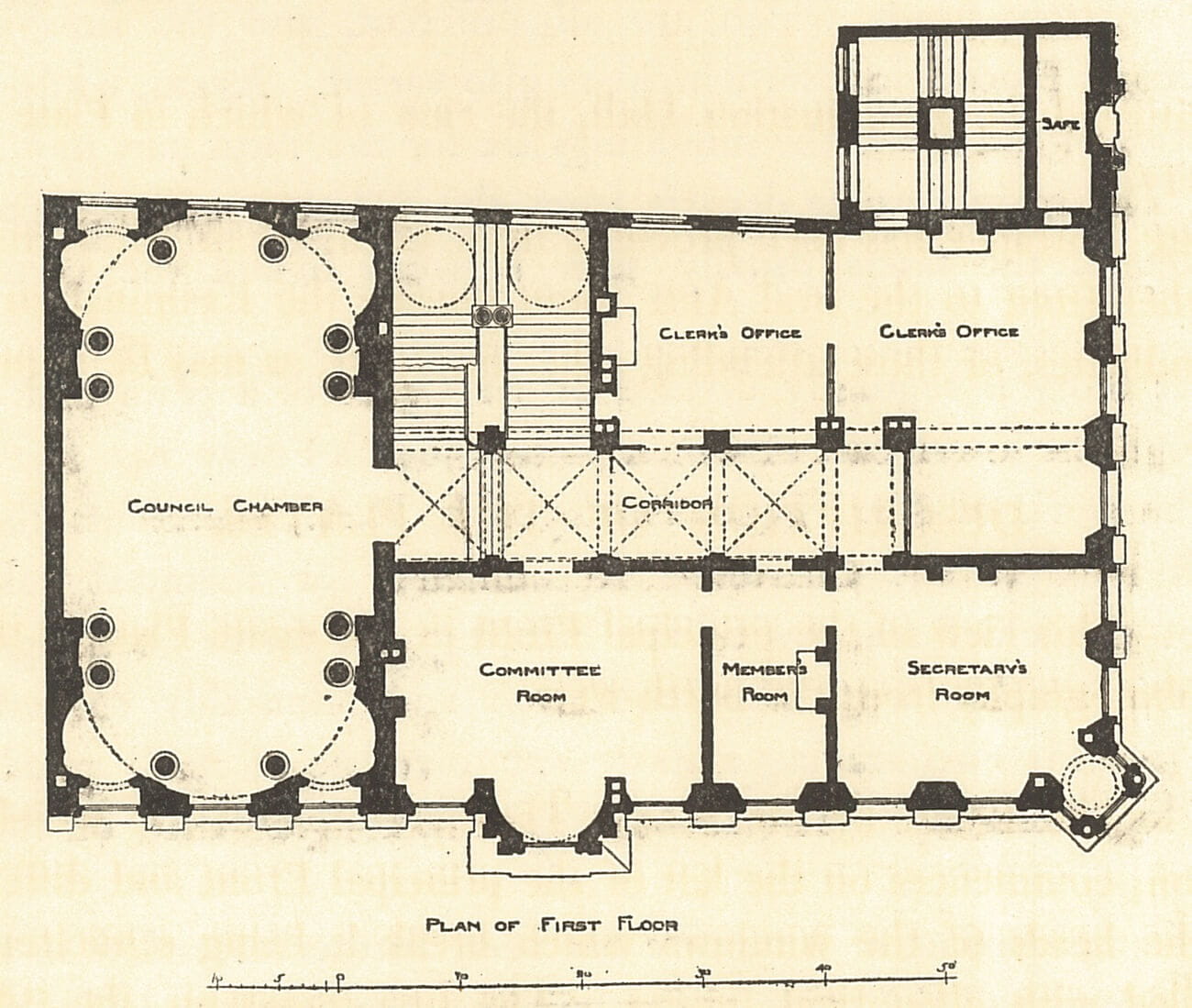

Opening of The Hall
THE members of the Institute who were present on this occasion having assembled and filled the large Hall to crowding point,—THE PRESIDENT OF THE INSTITUTE (Mr. Edwin Waterhouse, B.A., F.C.A.) said: Gentlemen, before we begin the business I think we may congratulate ourselves on being assembled together in our own building. (Cheers.) You are all aware that this building has been more or less made use of since Christmas, the examinations for December having been held in it: there has, therefore, been no formal opening; and I think we should do well if, at the present time, before we begin our business, we should at any rate give a cheer for the fact that we are assembled in the building -which has been created for our use. I wish somebody had been present on this occasion who could have declared the building open in better terms than I can, but, as you know, a great number of people are assembled together at the West end of London on a somewhat similar occasion. If it had not been for that we might have had some high functionary to express our congratulations at this time. We cannot carry on our work without getting into our new building, and we cannot get into our new building until it is opened: I therefore declare this building is opened. (Loud cheers.)

Extract from the Address of Mr Edwin Waterhouse, B.A., F.C.A. President
I need not dwell upon the statistics given in the Report with regard to the examinations of the year, which speak for themselves, and are, I think, satisfactory, but will pass on to the paragraph relating to our New Hall and Offices, and will congratulate you on the building in which we are now assembled being at last ready for our occupation. (Applause.) It seldom occurs that anticipations formed by persons about to engage in building operations as to the date when their labours will be completed are fulfilled. We find ourselves no exception to the general rule - many difficulties arose before we were able to get to work, and great and annoying delays were the result, but happily our labours are now at an end, and, subject to some internal decorations to be under-taken, when our walls are in a fit condition, and our finances permit, the building is complete.
I may remind you that a building for our Institute was contemplated at the time of our Charter, but it was not until the 11th of July, 1888, that a suitable site was procured, and the consent of the members of the Institute to the construction of the building obtained. The matter was then vigorously taken in hand under the able leadership of your past President, the late Mr. Arthur Cooper. The Institute will ever be under a debt of gratitude to him for the time and labour which he bestowed on the matter as Chairman of your Building Committee. (Hear, hear.) Mr. Cooper's death, which we deeply deplore as a great loss to your Council and Institute, is alluded to in the Council's Report, and we cannot but express our regret that he has not lived to see the building, in the construction of which he took so great an interest, open for use. (Applause.)
In the matter of the approaches to our site we cannot altogether congratulate ourselves, inasmuch as the wide thoroughfare which we were led to believe would be made to our building from Moorgate Street has not been constructed, notwithstanding the endeavours we have made to obtain the carrying out of the improvements which were at one time in contemplation. Though the beauties of our building are consequently somewhat hidden, we have no reason to complain of our central and convenient position, nor of the building itself, which in its design and in its adaptation to its uses is, I think, all that we could wish. Its artistic merits are described by many well qualified to express an opinion as very great. Mr. Belcher is to be congratulated on having produced an exterior second to none in the metropolis as a beautifully perfect example of Italian Renaissance architecture; the beauty of his work being in harmonious accord with the elaborate frieze of Mr. Thornycroft and the original and striking sculpture by Mr. Bates. The work by these two gentlemen, both honoured members of the Royal Academy is, in my opinion, of extreme beauty, and one cannot help regretting that such delicate stonework should he exposed to the smoke-laden atmosphere of the City. We may believe, however, that, oven after the purity of surface left by the chisel has passed away, the beauty of the work will still be apparent in the darker hues which the stone may then take - hues which will be more in accord with its surroundings. As stated in the Report, the Institute is under much obligation to Mr. Thornycroft for his kind gift of the sculptured figure of "Justice," and I should like to express the thanks of he Institute to Mr. Belcher, Mr. Thornycroft and Mr. Bates for all their labours in connection with our Building. I feel that our builders, Messrs. Coils & Sons, should also come in for a share of our thanks. The proof of a building is, however, in its use, and perhaps our architect might object to our passing an encomium on the builders' work before he gives his final certificate. While, therefore, deferring any formal vote of thanks for the excellence of the work done by them till a little nearer the close of our lease of 999 years for which the building is to last, we may assure them that we feel they have had our interests as well as their own good reputation at heart in the manner in which they have carried out their contract. (Hear, hear.)
Taken from Inauguration of the Hall. London May 10th & 11th 1893
Images
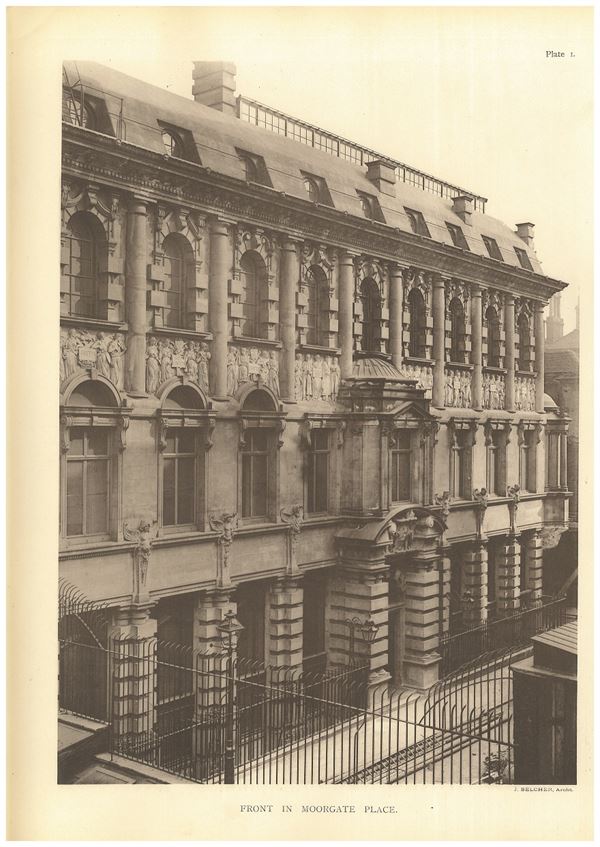
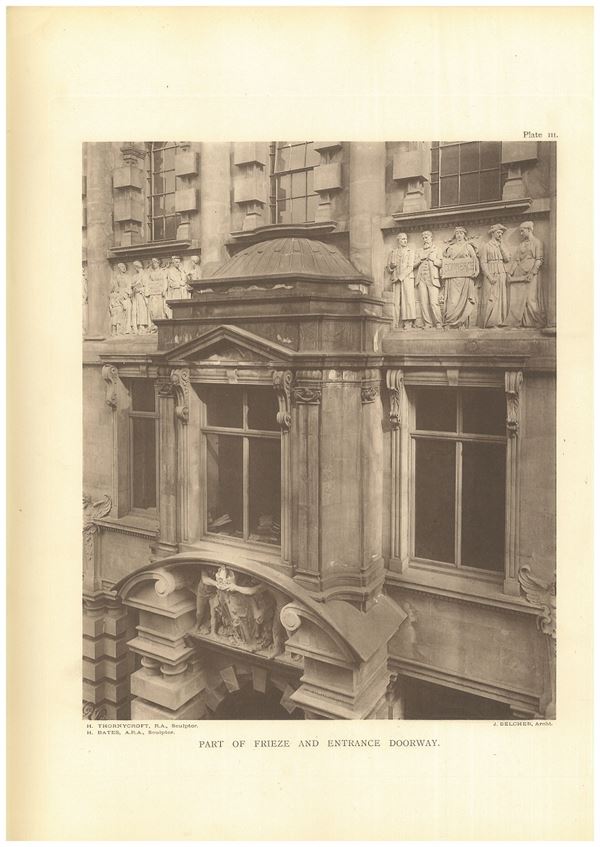
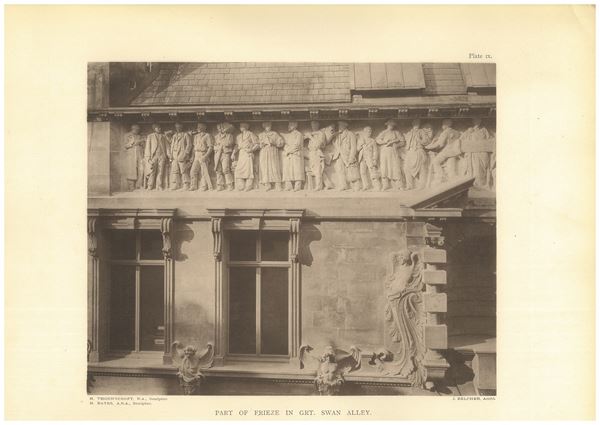
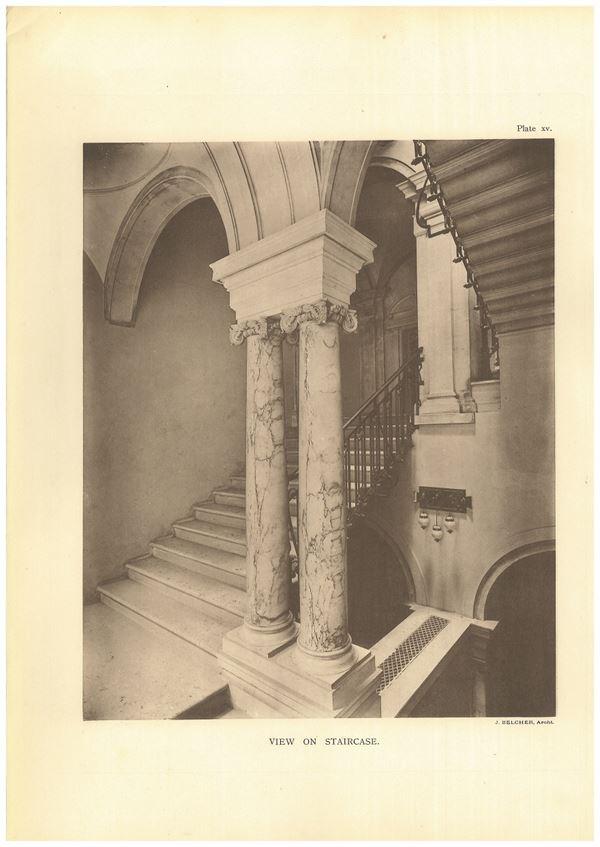
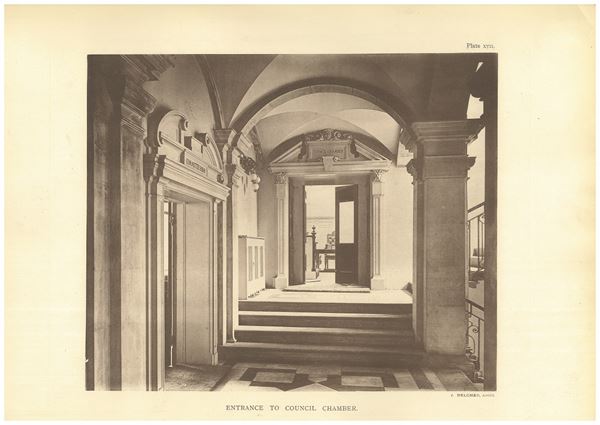
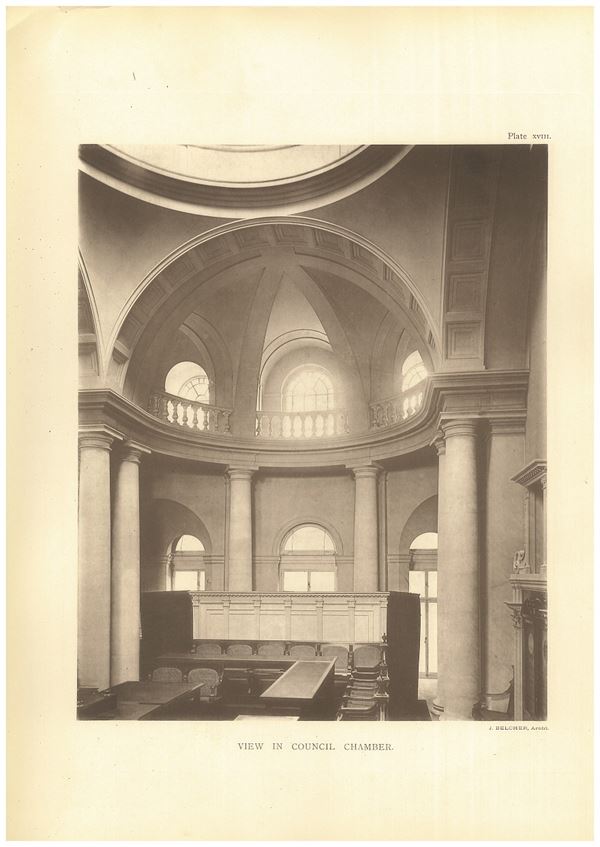
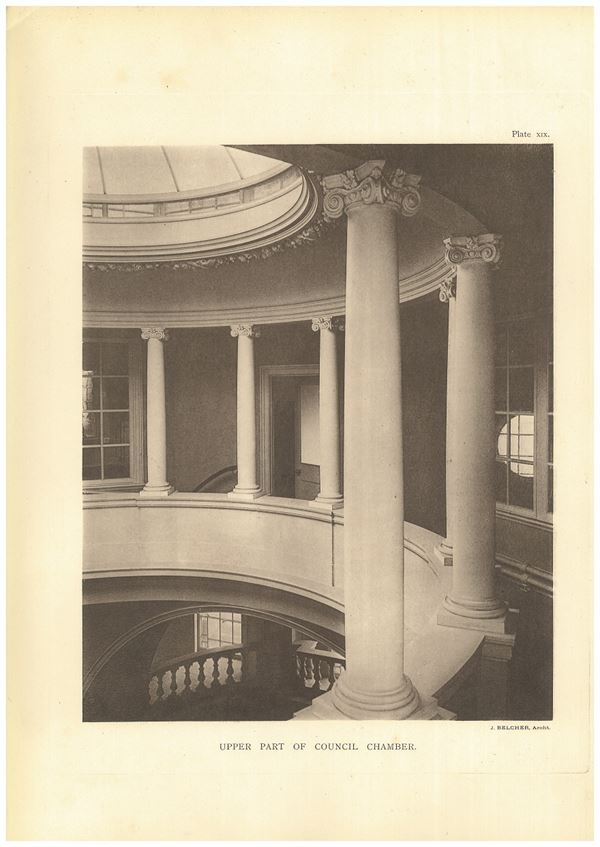
Further sources of information
Belcher and Chartered Accountants’ Hall
Chartered Accountants' Hall: Balancing history with shaping the future
In 2024, ICAEW published a 64-page booklet on the history of the building and its contents, which includes many photographs.
The ICAEW Library & Information Service holds a collection of books and articles on Chartered Accountants' Hall, covering the original building and the later extensions. See our Further reading page for details of these, as well as links to web pages on the artists and architects who have contributed to the building.
Can you help?
Do you have any old photographs of Chartered Accountants' Hall? We would love to see them!
We are particularly interested in seeing pictures of the following:
- The Henry Holiday stained glass windows, prior to being damaged in WW2
- The oval ante room to the Examination Hall/Oak Hall (Now Auditorium)
- Belcher's brass corona in the old Council Chamber (now Main Reception room)
Please email library@icaew.com
Can't find what you're looking for?
The ICAEW Library can give you the right information from trustworthy, professional sources that aren't freely available online. Contact us for expert help with your enquiries and research.
One Moorgate Place
Information on how to hire One Moorgate Place, home of Chartered Accountants' Hall, for conferences, meetings, weddings, parties, private dining and special occasions.

ICAEW accepts no responsibility for the content on any site to which a hypertext link from this site exists. The links are provided ‘as is’ with no warranty, express or implied, for the information provided within them. Please see the full copyright and disclaimer notice.